
When a Star Met Its Maker: A Black Hole's Record-Breaking Cosmic Roar
When a Star Met Its Maker: A Black Hole's Record-Breaking Cosmic Roar
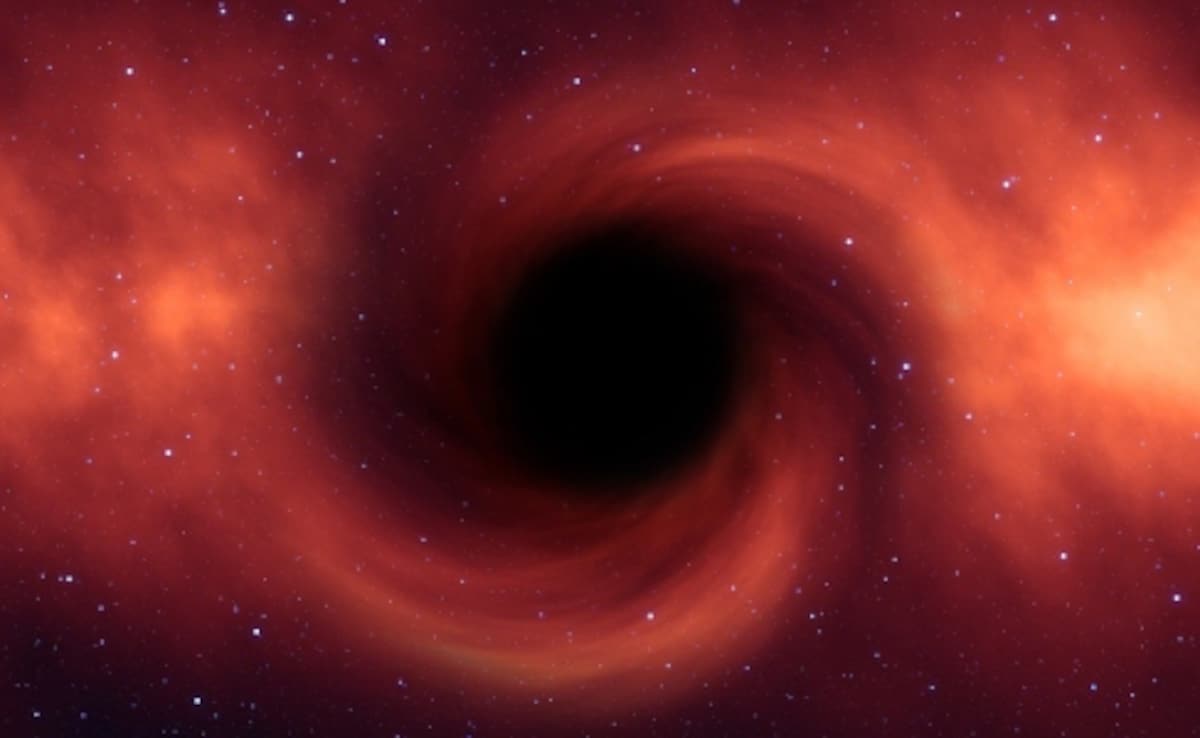
Imagine a cosmic predator so powerful it can tear apart a star, not just any star, but one significantly larger than our Sun. Scientists have recently witnessed such an astonishing event unfolding across unimaginable distances, observing the most energetic flare ever detected, born from the violent demise of a massive star consumed by a supermassive black hole. It’s a stark reminder of the universe's raw, untamed power and the incredible phenomena lurking in its depths.
This celestial drama began when an unlucky star wandered too close to the gravitational maw of a colossal black hole. As it approached, the black hole's immense tidal forces, far stronger on the star's near side than its far side, began to stretch and distort it, a process colloquially known as 'spaghettification'. This stellar shredding culminated in the star's complete disintegration.
The star's matter didn't just vanish; a significant portion of it was captured into a swirling accretion disk around the black hole. As this material spiraled inward at incredible speeds, friction heated it to extreme temperatures, causing it to emit an unprecedented burst of high-energy radiation across the electromagnetic spectrum – a flare so powerful it has set new records for cosmic luminosity.
Understanding Tidal Disruption Events
Astronomers refer to these dramatic stellar assassinations as Tidal Disruption Events (TDEs). While TDEs are not entirely new to science, this particular observation stands out due to the sheer energy released. It’s a testament to how extreme these cosmic interactions can be, providing a unique laboratory for studying physics under conditions impossible to replicate on Earth.
The record-setting nature of this flare provides invaluable data. It suggests that our current understanding of how black holes process stellar material might be incomplete, or perhaps that the dynamics involved with larger, more massive stars create even more spectacular fireworks. Each new observation refines our cosmic models, pushing the boundaries of what we know.
These events are critical windows into the behavior of supermassive black holes, which reside at the hearts of most galaxies, including our own Milky Way. By studying the light emitted during a TDE, scientists can infer properties of the black hole itself, such as its mass and spin, and understand how it interacts with its immediate environment.
The Mechanics of Cosmic Fireworks
A portion of the star's shredded remains is inevitably swallowed by the black hole, crossing its event horizon, from which nothing, not even light, can escape. However, the remainder is often ejected outwards in powerful jets of plasma, contributing to the observed flare. It's a complex dance of accretion, ejection, and intense radiation, showcasing the intricate processes at play in these extreme environments.
The fact that we can detect such a distant and fleeting event underscores the incredible progress in astronomical instrumentation and observational techniques. Our telescopes, both ground-based and in orbit, are becoming increasingly sensitive, allowing us to capture these brief, yet immensely powerful, cosmic light shows.
This discovery truly brings to life the dynamic and often violent nature of the cosmos. It reminds us that while our solar system seems stable, the universe is a place of constant change, immense forces, and breathtaking spectacles that far surpass human comprehension in scale and power.
Looking Ahead
This record-breaking flare will undoubtedly spur further research, prompting astrophysicists to revisit existing models and explore new theories about black hole feeding frenzies. It poses questions about the frequency of such events, the diversity of stars involved, and how these powerful flares might influence the evolution of galaxies.
The ongoing observation of this particular TDE, and others like it, will continue to provide a wealth of data. Each photon captured tells a story, helping us piece together the enigmatic lives of black holes and their profound impact on the structure of the universe.
Ultimately, this cosmic feast and its record-setting flare serve as a powerful reminder of the universe's endless capacity for wonder. As we continue to gaze skyward, each new discovery peels back another layer of mystery, inviting us to contemplate our place in a cosmos both terrifyingly powerful and exquisitely beautiful.
References & External Links
- NASA: Understanding Black Holes
- Space.com: Supermassive Black Holes and Their Mysteries
- Nature Astronomy: New Insights into Tidal Disruption Events
Tags
Black hole, Supermassive black hole, Stellar destruction, Energetic flare, Astrophysics, Cosmic event, Astronomy, Tidal disruption event, Star, Universe
